lunes, 31 de enero de 2011

The pale blue dot


The Pale Blue Dot is the title of a photograph taken by the probe Voyager 1 in 1990 as it was leaving the Solar System. The photograph was taken by request of Carl Sagan.


Carl Sagan was an astronomer and a great science communicator, as we can acknowledge in the Cosmos series. He always tried to relate the knowledge of the Universe with human being, showing us as a part of it, inside a complex web of relationships, and he succeeded magnificently.
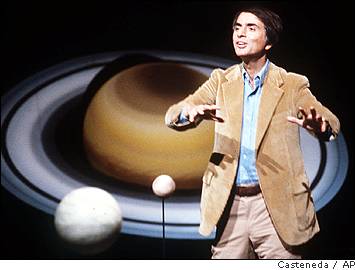


As an example of it we have the comments he made about the photograph, which make us reflect on the special thing about the planet we live in, about the relative importance of our lives, about humility and responsibility. Anyway, each to his own reflection, I leave his comment here for you:
Look again at that dot. That's here, that's home, that's us. On it everyone you love, everyone you know, everyone you ever heard of, every human being who ever was, lived out their lives. The aggregate of our joy and suffering, thousands of confident religions, ideologies, and economic doctrines, every hunter and forager, every hero and coward, every creator and destroyer of civilization, every king and peasant, every young couple in love, every mother and father, hopeful child, inventor and explorer, every teacher of morals, every corrupt politician, every "superstar," every "supreme leader," every saint and sinner in the history of our species lived there – on a mote of dust suspended in a sunbeam.
The Earth is a very small stage in a vast cosmic arena. Think of the rivers of blood spilled by all those generals and emperors so that, in glory and triumph, they could become the momentary masters of a fraction of a dot. Think of the endless cruelties visited by the inhabitants of one corner of this pixel on the scarcely distinguishable inhabitants of some other corner, how frequent their misunderstandings, how eager they are to kill one another, how fervent their hatreds.
Our posturings, our imagined self-importance, the delusion that we have some privileged position in the Universe, are challenged by this point of pale light. Our planet is a lonely speck in the great enveloping cosmic dark. In our obscurity, in all this vastness, there is no hint that help will come from elsewhere to save us from ourselves.
The Earth is the only world known so far to harbor life. There is nowhere else, at least in the near future, to which our species could migrate. Visit, yes. Settle, not yet. Like it or not, for the moment the Earth is where we make our stand.
It has been said that astronomy is a humbling and character-building experience. There is perhaps no better demonstration of the folly of human conceits than this distant image of our tiny world. To me, it underscores our responsibility to deal more kindly with one another, and to preserve and cherish the pale blue dot, the only home we've ever known.


jueves, 27 de enero de 2011

Economic growth and natural resources


Growth of the economy was largely due to exploitation of natural resources (oil, coal, wood, minerals, soil, fishing...) Transport is a central piece in the economy, which has allowed to get all kind of products delivered to a larger number of customers in an also growing population, therefore expanding the market exponentially. A larger market entails a higher production and, to this end, the utilization of a larger number of resources either for the final product as for its production.

At the start of the industrial revolution natural resources hadn’t been exploited intensively, and therefore their exploitation seemed inexhaustible. The industrial revolution favoured the growth and development of capitalism, which is based on an unlimited growth. This continuous growth involves an increasingly higher production and consumption in a world that is not infinite, in which lots of its resources are not renewable, and although a great part of them is (wood, soil, fishing, etc), its renewal rate is slower than the exploitation we inflict on them.   

It is logical to think that we will get to a point in which our growth won’t be compatible with the existing resources. We have already reached that moment, we are consuming more than nature is able to offer us, and what is worse, the incredibly bad administration and distribution we make of these valuable resources.

This topic will be extended in future posts, for the time being I leave you with a thought-provoking image. In it you can see the consumption of mineral resources per capita in the USA and the reserves left (in years) according to the current consumption rate and according to half of the current rate. It is interesting to think about what will happen as we start exhausting them... our ability to recycle these minerals starting from already made and thrown away objects will also be very important.


¿What are natural resources?


When we talk about natural resources we use to think in material goods as raw materials, or food. Natural resources would actually include a wide range of services ecosystems can offer us. Yes, ecosystems do offer us services; they are not only a landscape to gaze at or to go take a walk in. These services can be divided in four types: support (nutrient cycle, soil formation, vegetal primary production...), supplies (food, water, wood, fuel...), regulation (climate, floods, diseases...), and culture (educational, recreational, aesthetic, spiritual...) (Millenium Ecosystem Assesment, 2005).  It is worth mentioning that this four types don’t exist isolated in different ecosystems, they are different types of services that ecosystems give us as a whole. To understand this it is important to take a holistic point of view, understand that the flows of matter and energy running in them, from which we obtain these services, they do it thanks to an internal “gear mechanism/engine” constituted by the different  species that inhabit them (from  a monkey  to a bacterium) , the environment they live in, the relationship between them, with other ecosystems, and also with human being.

The riches that ecosystems give us emerged from the interaction of all their components, and although some species or geological processes are key for different natural processes to take place, it is also worth mentioning that the rest of species can play a very important role regulating key species. This is the way to develop a vision of nature as an integrated system in which every component plays an important role.

With this perspective it may be easier to understand that nature is not a pantry to take anything we want from without thinking about consequences.